
What Brands Actually Want in 2026
09/12/2025
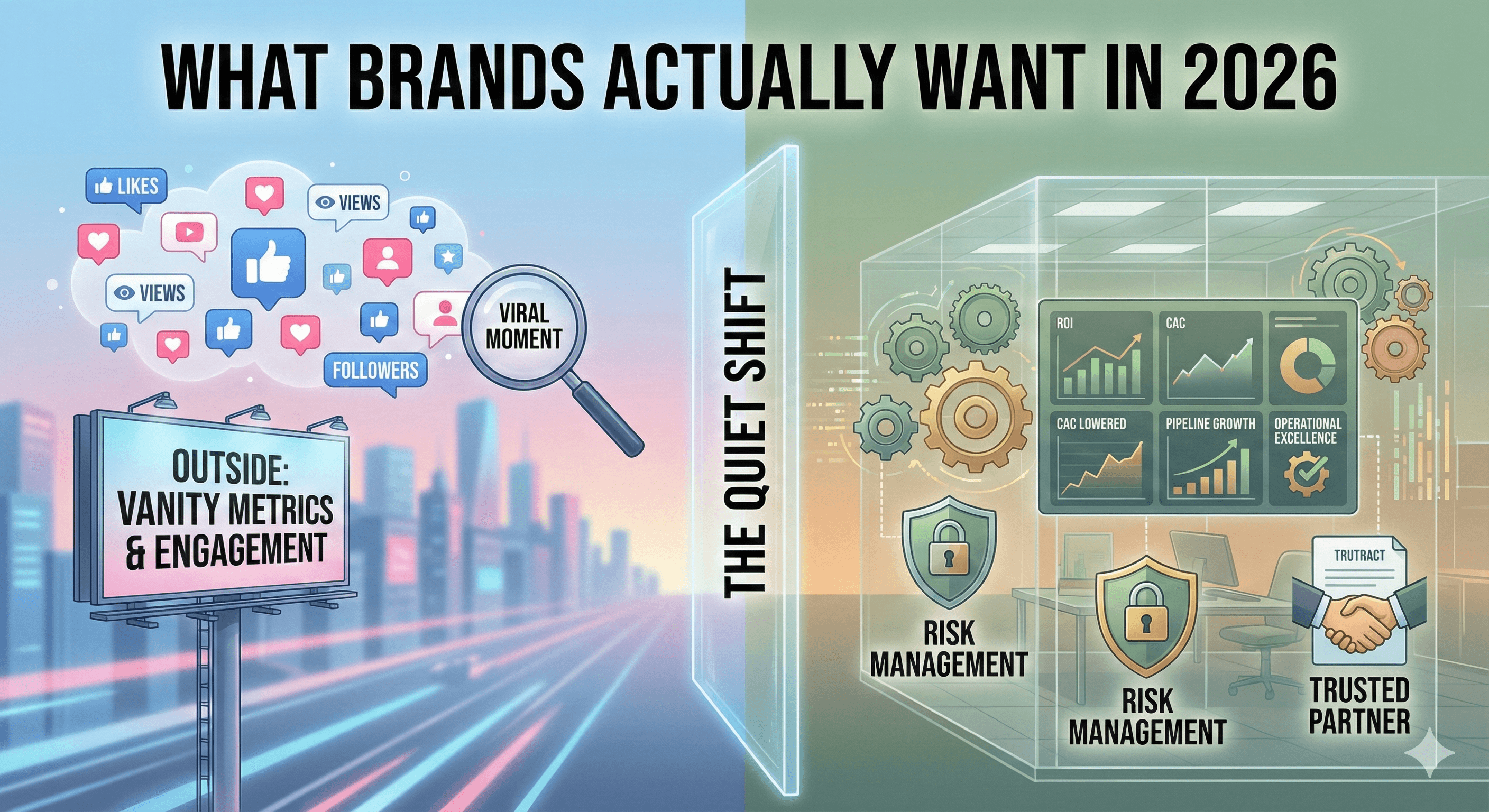
There’s a quiet shift happening inside marketing teams.
On the outside, the industry still talks about “reach,” “engagement,” and “viral moments.” But inside, where budgets are actually signed off, the conversation has changed.
As we move into 2026, brands don’t just want creators or agencies that can make noise. They want partners who can create outcomes, run clean operations, and provide a hedge against automation.
If you’re still pitching follower counts and vibes, you’re going to feel the disconnect growing.
Let’s get specific about what brand teams actually care about now.
Outcomes over topics
The first question a CMO asks is no longer “How many views did we get?” It’s “What did this actually do for the business?”
Did it lower Customer Acquisition Costs (CAC)?
Did it bring in high-intent traffic?
Did it drive sign-ups, trials, or sales?
Impressions are now table stakes. Attention is an input, not the outcome.
The creators and agencies winning in 2026 are the ones who can sit in a room with a brand and speak the language of the P&L. They understand the difference between vanity metrics and the numbers that actually move budgets.
This doesn’t mean every campaign must be a hard-sell, direct-response play. It means you know where your work sits in the funnel. If your pitch deck opens with “I have X followers and Y average views,” it’s already misaligned. The brand is asking: “If I give this person budget, what happens next?”
Operations Decide The Renewal.
There’s a reason brands keep going back to the same creators and agencies, even when others have bigger audiences.
It’s operations.
Does the partnership feel plug-and-play, or does it feel like chaos?
Are briefs turned into clear plans quickly?
Do timelines get hit without chasing?
Is there one person who owns the work and communicates like a professional?
Inside brands, the pain point is rarely “We can’t find creators.” The pain is “We don’t have the mental bandwidth to manage another messy campaign.”
In 2026, operational excellence is a differentiator. Agencies that manage everything from contracting to reporting in a clean, predictable way will keep winning renewals while everyone else blames “budget cuts.”
If you want bigger brand budgets, don’t just upgrade your content. Upgrade your process.
3. Risk Is The Invisible Brief
Every marketing leader is balancing growth with protection. They are asking:
Is this creator brand-safe?
Does their wider content feel aligned with our values?
If something goes wrong, how exposed are we?
We’re in an era where screenshots live forever. A collaboration that looks smart on a moodboard can become a reputational nightmare if the wrong clip circulates.
This doesn’t mean brands want bland, personality-free content. It means they want brave ideas inside a safe relationship.
When you position yourself as a long-term partner, risk management becomes part of your value. You show you understand the guardrails. You demonstrate how you handle feedback. You point to a track record of hitting the line without crossing it.
Asset Utility (The "Ad-Ready" Requirement)
Here is the angle most creators miss: Brands need content for their paid channels more than they need it for your organic feed.
In 2026, organic reach is volatile. Brands want assets that perform after the initial post has died down. They are looking for:
Whitelisting rights: Can they run ads through your handle?
Modular content: Can they cut your 60-second video into three 15-second hooks for TikTok Ads?
High-res deliverables: Are you sending the raw files so their editor can iterate?
If you treat a partnership as a "one-and-done" post, you are leaving money on the table. The winning pitch in 2026 is: "I will create content that engages my audience, but I will also give you a library of assets that lowers your paid ad costs for the next 3 months."
The "Human Premium" (Trust in the Age of AI)
With AI flooding feeds with synthetic content, human trust is becoming the ultimate luxury good.
Brands can generate "perfect" copy and images with AI for free. What they cannot generate is the deep, messy, human trust you have with your audience.
In 2026, brands are paying a premium for:
Point of View: A unique perspective that an algorithm wouldn't predict.
Community Depth: Not just how many people follow you, but how many people believe you.
Reality: Showing the texture of real life, real skin, and real opinions.
Your competitive advantage is no longer "high production value" (AI can do that). Your advantage is your humanity. Lean into it.
What To Do With This
If you take these realities seriously, your positioning starts to change.
Audit your pitch: Stop leading with "I post great content" and start leading with "Here is the business outcome we drive."
Tighten operations: Make your campaigns feel boringly reliable from the inside.
Sell the asset, not just the post: Offer usage rights and raw files as a core part of your package.
Define your "Human" value: Be clearer about who listens to you and why they trust you.
The creator economy isn’t shrinking; it’s maturing. Budgets are consolidating into fewer, deeper relationships with partners who can truly plug into how brands work.
The question isn’t “How do I get a brand’s attention?” It’s “How do I become the partner they can trust with their budget, their time, and their reputation?”