Why “cost per thousand views” is costing you money
15/12/25
The Problem with CPM (And What Should Replace It)
Why “cost per thousand views” is costing you money
CPM was designed for a simpler world.
You bought media in bulk, paid a fixed price for a thousand eyeballs, and hoped the message landed.
In 2026, that logic is creaking.
Attention is fragmented. Creators have real relationships with their audiences. Content lives organically, in paid, on landing pages and inside email flows.
Yet most creator budgets are still built on a single line:
“£X per 1,000 impressions.”
This isn’t just old-school. It quietly distorts how brands spend money and shrinks what creators are worth.
It’s time to stop obsessing over the cost of the view, and start looking at the value of the asset.
1. The lie of equal views
On a spreadsheet, CPM treats every impression as identical.
A half-second scroll past a meme is valued exactly the same as a 45-second deep-dive by a trusted expert.
On paper, they’re both “one impression”.
In reality, one is noise. The other is trust.
A creator who has spent years building authority in a niche shouldn’t be priced like a generic billboard.
When you flatten everything to CPM, you lose that nuance. Brands end up chasing cheap reach; creators who actually drive action get undervalued.
2. The race to the bottom
If you judge everything by CPM, you optimise for the wrong thing.
On the brand side, the pressure is:
“How do we drive the price down?”
On the creator side, the pressure is:
“How do we push the views up?”
The result:
Creators make broad, generic content to spike numbers, even if it drifts away from the audience that actually buys things.
Brands feel like they’re winning because the CPM is low, but when you zoom out a few weeks, sales and sign-ups are soft.
CPM encourages everyone to optimise around price of the impression, not value of the relationship.
3. CPM ignores the asset you’re actually buying
Creator campaigns don’t just produce views. They produce assets.
A strong piece of content can be:
Run as a high-performing paid ad for months
Dropped onto product pages to lift conversion
Turned into UGC variations for performance media
Used in welcome flows and win-back emails
Clipped into multiple shorts across channels
CPM sees none of this. It measures the “media” (the impression) and ignores the “IP” (the creative).
It’s like valuing a house based only on how many people walk past the front door, instead of what it’s actually like to live inside.
Two campaigns at the same CPM can have totally different afterlives: one dies in the feed, the other becomes a workhorse asset.
Right now, CPM doesn’t know the difference.

4. It quietly locks creators into underpricing
When CPM is the main variable, it becomes very hard for creators to hold their price.
If one creator is at £20 CPM and another comes in at £10 CPM, it looks like a simple comparison. On paper, procurement has “saved money”.
The nuance: audience quality, trust, brand fit, creative strength, asset lifespaN, is hard to defend when the framework is just cost per thousand.
Over time, this pushes creators to underquote to win briefs. That erodes the perceived value of the whole category and makes it harder for anyone to invest properly in production, strategy and operations.
Everyone ends up competing to be the cheapest line on a media plan instead of the most valuable partner on it.
5. So what should replace CPM?
We don’t need to throw CPM in the bin. It still has value as a reference metric.
But it can’t sit at the centre of the conversation.
A healthier model blends three lenses:
① Objective-based pricing
Start with the business outcome:
Are we trying to generate leads?
Drive sign-ups or trials?
Educate a niche audience?
Create evergreen assets for performance?
Work backwards from the commercial value of that shift. A campaign designed to move revenue should not be priced the same way as a pure awareness splash just because the impression count is similar.
② Audience and context weighting
Not all attention is equal.
A niche creator with deep trust in a high-value vertical should be priced differently to broad, low-intent reach.
Build in a premium for context:
How aligned is this audience with the product?
How much trust does the creator have?
How deep is the typical watch or read?
③ Asset and usage value
Separate media from IP & rights.
If a brand wants to:
Run the content in paid for six months
Use it across website, CRM and retail
Localise it or cut it into multiple variants
…that’s valuable IP. The usage should be priced explicitly, not quietly folded into a CPM on the initial post.
6. How brands can start shifting the conversation
If you’re on the brand or agency side:
In briefs, be clear on what success looks like beyond impressions and where the content will live after posting.
In negotiations, resist forcing everything into CPM. Ask: “What are we really buying here, reach, authority, creative, or a reusable asset suite?”
In reporting, widen the lens. Track CPM, sure but also look at saves, click behaviour, sentiment, downstream performance in paid, lift on key pages, and reuse.
The more you talk in these terms, the easier it becomes to justify deeper, longer partnerships with the right creators, not just the cheapest ones.
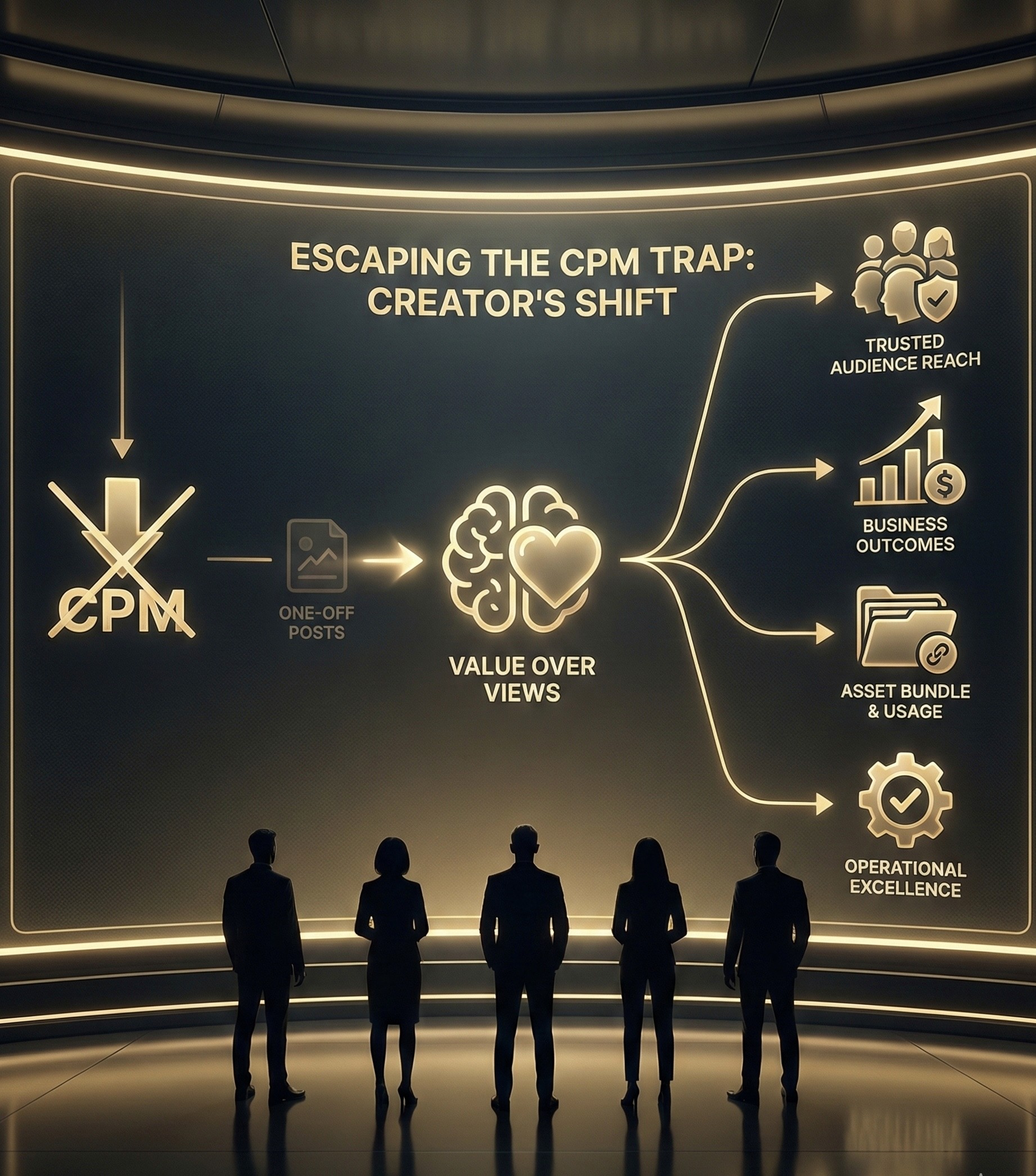
7. How creators can escape the CPM trap
If you’re a creator:
Stop leading with “My CPM is X.”
Start leading with:
Who you reach and why they trust you
The kinds of outcomes your content tends to drive
The asset bundle and usage you’re offering
How you run campaigns operationally
Package your work around:
Campaign concepts, not one-off posts
Content + usage tiers (organic only, 3-month paid, 12-month multi-channel, etc.)
Test-and-learn frameworks, where you actively suggest new hooks or edits based on performance
CPM can sit in the background as hygiene, not your headline.
The takeaway
The market isn’t short on impressions. It’s short on partners who understand what that attention is actually worth.
If you’re a brand, stop asking:
“What’s the lowest CPM we can get?”
Start asking:
“What asset are we building, and what can it do for us over time?”
If you’re a creator, stop quoting purely on views. Quote on the value you create and the assets you deliver.
That’s where the next wave of serious creator budgets will live.