Why your creator programme doesn’t need more people. It needs a system.
23/12/2025
There’s a pattern I keep seeing.
The moment a brand decides to “take creators seriously”, the first instinct is headcount.
“Let’s hire a creator manager.”
Then a second one.
Then a coordinator to chase contracts and assets.
Then a part-time designer to resize everything for every platform.
Very quickly, the creator line on the P&L is no longer just fees and media.
It’s salaries, tools, and meetings.
The work gets slower. Margins get worse.
And everyone quietly starts saying, “This is hard to scale.”
Most of that pain isn’t about creators.
It’s about operations.
If the system is manual, creator work will always feel expensive.
The Sobio lens: separate thinking from throughput
There are really only two jobs inside a creator programme:
Decide what to do
Get it done, consistently, without chaos
The first is strategy: portfolio, partners, formats, budgets.
The second is operations: briefs, approvals, assets, reporting.
What most teams do is throw people at the second bucket.
Every new creator, every new campaign, adds more coordination work.
So they keep hiring coordinators.
A healthier approach is to assume:
“We need a small number of people who think clearly, and a system that does the repetitive work.”
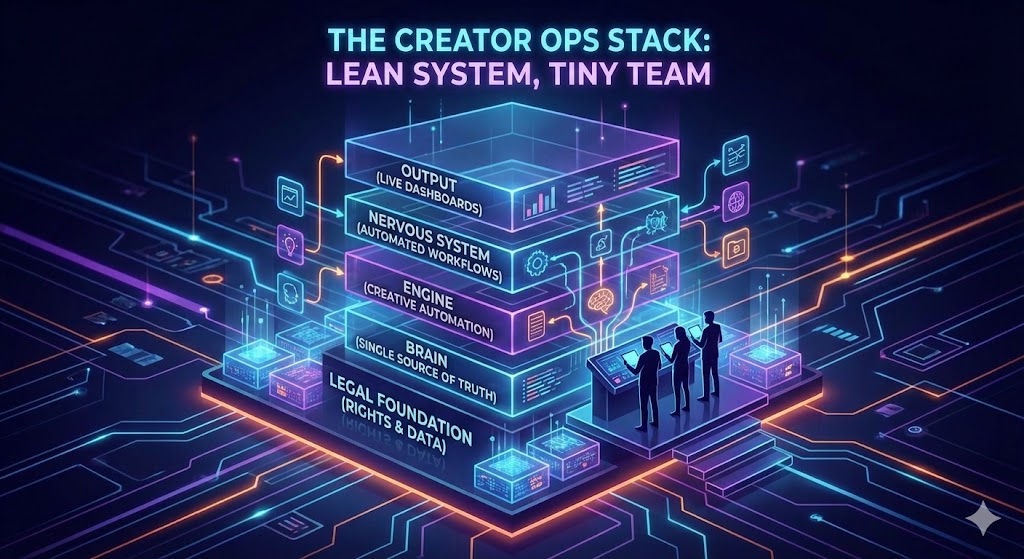
That’s what a Creator Ops Stack actually is.
Not a collection of apps, but a way of making sure:
you always know where things are
nobody is manually moving files around
reporting doesn’t require digging for screenshots
creators get a consistent, professional experience
The deliverable isn’t a dashboard. It’s unit economics: more output, with a smaller team, at a lower effective cost per asset.
Why most creator teams drown
If you map the day of a typical “creator manager”, it’s rarely strategy.
It’s chasing people for product shots.
It’s updating someone in paid media about which file is “final final”.
It’s replying to a creator who can’t find the latest brief.
It’s looking for a contract in an inbox from six months ago.
None of those tasks are complicated.
They’re just constant.
Now multiply that by 10–15 creators and 3–4 stakeholders per project.
Suddenly the job is less “build a creator system” and more “run around closing tiny loops”.
If you’re not careful, you end up with a team that’s:
overworked
under-leveraged
and still struggling to answer basic questions like “What’s live this week?”
The answer is not: “hire another pair of hands”.
It’s: “build an operating system so those hands aren’t doing low-value work”.
Layer 1 – A brain: one place that knows what’s going on
The first non-negotiable is a single source of truth.
Not a WhatsApp chat.
Not a Google Drive with 19 folders called “Final”.
One place where every creator relationship lives from brief to report.
In practice, that’s a project hub: ClickUp, Asana, Monday, Notion – the label doesn’t matter as much as the discipline.
For each creator, you should be able to open one record and see:
the brief
the agreed deliverables and dates
the current status
the latest file versions
the performance snapshot once it’s live
You move from “Who has the latest version?” to “Check the project”.
Approvals become a status change, not a four-email chain.
If someone leaves the team, the knowledge stays.
The test is simple:
If your strategy lead can’t tell, in under 5 minutes, what’s coming out next week and where every piece is in the pipeline, you don’t have a brain. You have scattered memory.
Layer 2 – An engine: creative variations without manual grind
Once a creator sends a hero asset, the old workflow goes like this:
Send it to design.
Resize for Stories.
Resize for Reels.
Cut a shorter version.
Export for YouTube Shorts.
Resize for paid placements.
Add a different CTA.
Repeat, repeat, repeat.
Four hours later, you’ve produced variations that software could have generated in ten minutes.
This is where creative automation tools earn their keep.
Upload one asset, define a few templates, and let the system spin out all the crops, ratios and caption placements you need.
You don’t use automation to make the work more generic.
You use it to free your designer from pushing pixels so they have time to think about what actually moves the needle:
what’s the hook?
what’s the first frame?
what headline is worth testing?
High-end judgment on the inputs.
Automation on the repetitive outputs.
That’s how you go from “one asset per brief” to “a whole test matrix” without adding another salary line.
Layer 3 – A nervous system: tools talking to each other
The next layer is connectivity.
Most of the friction in creator work is handover:
“The file is in Drive, can someone upload it to the hub?”
“Can someone tell paid the assets are ready?”
“Has legal seen this version yet?”
If every handover relies on a human remembering to send something, you’ll always be at capacity.
Workflow automation is how you wire the stack together.
You can set up flows where:
A creator drops their final assets into a shared folder.
The system automatically attaches them to the right project.
The status moves from “In production” to “Ready for review”.
A message goes to the right Slack channel.
A thumbnail goes into a “ready-to-test” database for the paid team.
Nobody had to remember to do any of that.
The machine moved the work forward.
Same on the other side: when a campaign ends, performance data flows back into the same hub, so the next brief can reference what actually happened rather than what people remember.
The mental model is:
People decide.
The stack handles the plumbing.
Layer 4 – A legal foundation: rights, not vibes
There is one place where you absolutely cannot rely on memory: rights.
If you’re serious about treating creator content as an asset class, you need to know, at a glance:
what you’re allowed to reuse
where you can run it
when those rights expire
where exclusivity starts and ends
For that, you don’t need expensive software.
You need a simple, structured register.
Call it a creator “cap table” if you like: one line per partner, one view that shows contracts, rights, dates and constraints.
When someone in performance says, “Can we still use that video in paid?”, the answer shouldn’t require digging in email. It should be one lookup.
Two things happen when you treat rights properly:
You reduce risk – no accidental breaches, no awkward calls from legal.
And you increase yield – because you have the confidence to actually repurpose and amplify the content you’ve already paid for.
You’re not just commissioning posts. You’re managing inventory.
Layer 5 – Output: reporting that doesn’t need a hero
The final layer is the one everyone wants first: dashboards.
But a dashboard is only as good as the plumbing underneath it.
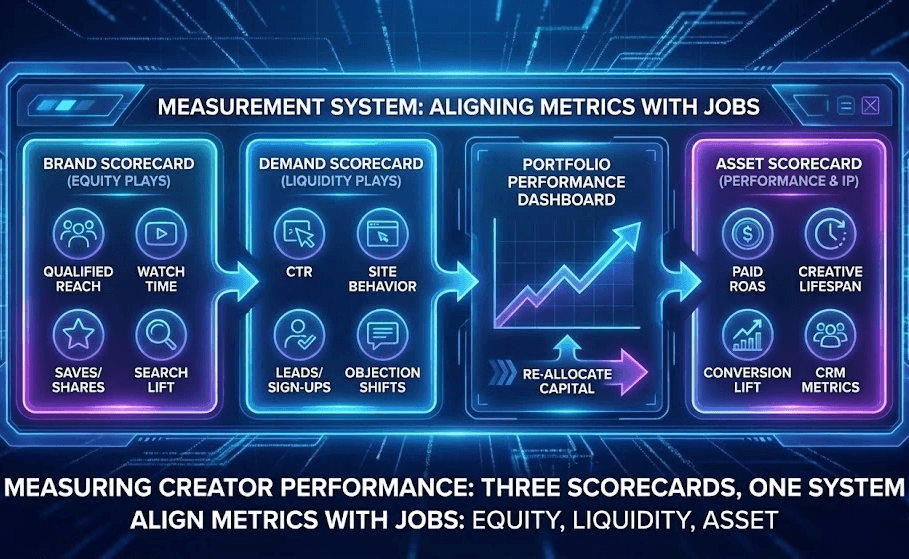
Once your projects, assets and performance data are flowing into the same system, reporting becomes less of a monthly “build” and more of a live view:
which creators are active
what’s gone live this month
how each partner is performing on the metrics that matter to you
where your budget is actually going
The right lens depends on who’s looking.
Your marketing lead wants channel-level performance.
Your founder or CFO wants to know whether creator spend is lowering blended CAC or lifting LTV.
You, as an operator, want to see which creators, formats and workflows are genuinely efficient.
If every report requires a mini-investigation, the system isn’t finished.
The goal is to have answers ready before the question arrives.
The economics of a stack vs. a headcount treadmill
It’s worth looking at the numbers, even roughly.
One version of a creator team:
A strategy lead, two full-time coordinators, an in-house designer, a part-time analyst.
Hours spent on status updates, file chasing and manual resizing.
Another version:
A strategy lead, one hybrid operator, fractional design support, and a well-built ops stack that automates most of the repetitive work.
In the first version, people are the system.
In the second, the system supports the people.
The difference isn’t just cost.
It shows up in decisions:
In a manual setup, everyone is too busy to step back and ask, “Do we even need this?”
In a systems-led setup, there is enough breathing room to decide which creators should be upgraded to retainers, which should be cut, and which experiments are actually worth running.
That’s where the compounding lives.
Build vs buy: platform or stack?
At some point, every brand hits the same question:
“Should we buy an all-in-one creator platform, or stitch together our own stack?”
The honest answer is: it depends on your scale and your appetite for building.
If you’re at early or mid-stage, a lightweight stack built from tools you already use is usually the right call. You learn your own workflows by building them. You stay flexible. You don’t lock yourself into someone else’s idea of how you should work.
If you’re at enterprise scale, there’s a point where a more opinionated platform is worth the trade-off because time-to-value trumps flexibility.
What doesn’t change is the principle:
You need a brain, an engine, a nervous system, a legal foundation and an output layer.
Whether that’s inside one platform or four connected tools is an implementation detail.
The shift
The old pattern:
“We’re doing more creator activity, we’re overwhelmed, let’s hire another coordinator.”
The new pattern:
“We’re doing more creator activity, so let’s upgrade the system and keep the team small, sharp and focused on decisions, not admin.”
For brands, that shift turns creator work from a coordination headache into an operational asset.
For teams, it replaces the constant firefighting with a calmer, more strategic pace.
The goal isn’t to build a “fancy stack”.
It’s to reach a point where your creator programme feels like any other well-run channel:
Predictable.
Measurable.
Scalable.
Not because you have more people,
but because the system is finally doing its job.