The B2B creator economy is the most underserved, under-financed, and under-optimised market in creator marketing. And it is about to blow up.
12/01/25
The B2B creator economy is the most underserved, under-financed, and under-optimised market in creator marketing. And it is about to blow up.
Total B2B spend is around $500 billion. 51% of B2B campaigns now include influencer partnerships.[1] Yet most of the conversation still centres on consumer brands. Most tools are built for Instagram and TikTok. B2B is an afterthought.
That leaves an $80+ billion gap for brands that know how to build proper B2B creator systems.
Why B2B is different
B2B creator marketing is not just B2C with suits.
Decision-maker audience, not consumer audience
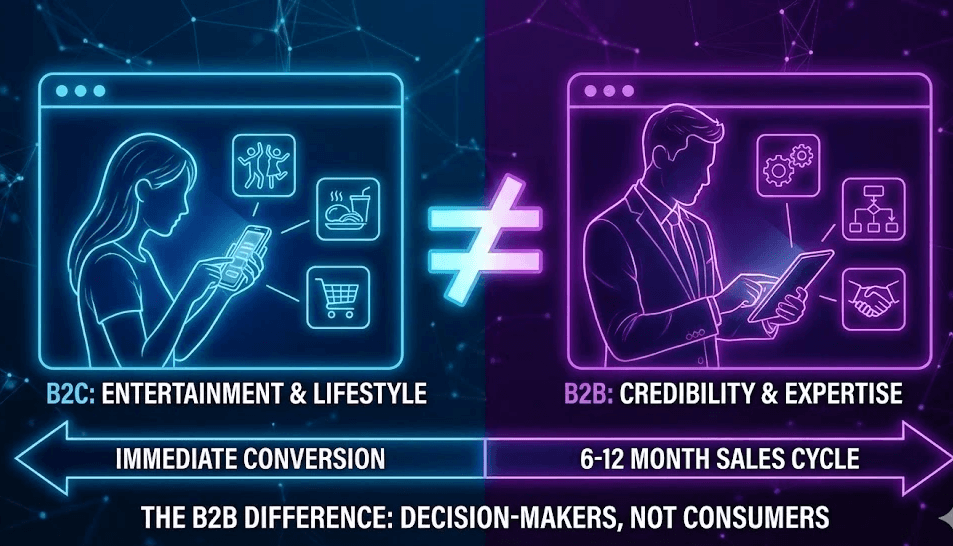
B2C creators optimise for entertainment, lifestyle, emotion. B2B creators optimise for credibility, expertise, and business relevance. An engineer scrolling LinkedIn at lunch is thinking very differently from a consumer scrolling Instagram at night.
Sales cycles are measured in months, not days
A single B2B creator post will not close a deal. It plants a seed with a decision-maker who then moves through a 6–12 month buying process. Attribution is messy; influence is real.
Approval and compliance are intense
A B2C influencer can post almost anything. A B2B creator in finance, healthcare or enterprise software often needs legal and compliance review. Lead times are weeks, not days.
Niches are narrow and explicit
B2B creators talk to clear segments such as “procurement directors in manufacturing” or “CTOs at Series B SaaS companies.” Targeting is sharper and easier to define.
Thought leadership matters more than personality
The best B2B creators are known for frameworks, case studies and sharp thinking more than lifestyle. That changes who the “top creators” actually are.
The B2B creator tier list
The hierarchy looks different from consumer platforms:
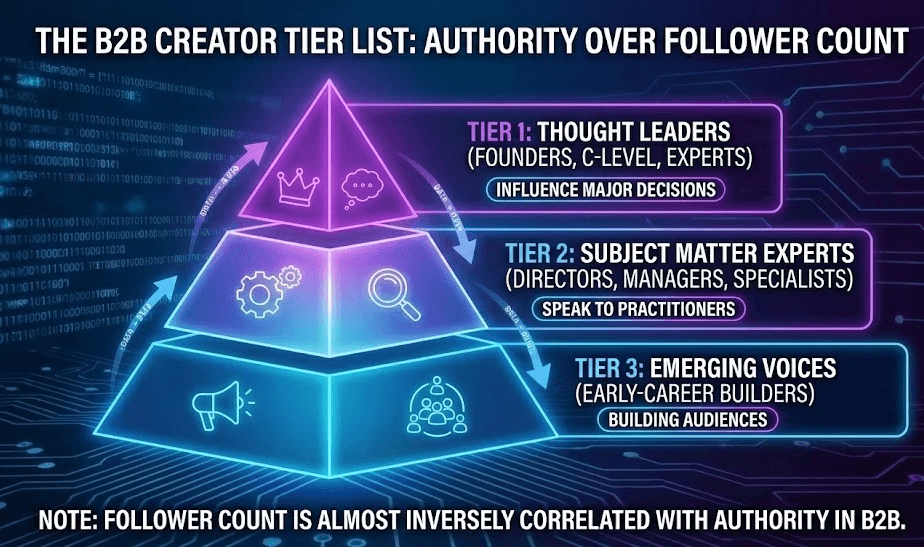
Tier 1 – Thought leaders
Founders, C-level executives, recognised industry experts. Examples: Naval Ravikant, Paul Graham, Satya Nadella when they post. They might have 50K to 2M followers, but the real leverage is the weight they carry inside their niche.
Typical pricing: 10K to 50K per post because they can tilt major decisions.
Tier 2 – Subject matter experts
Directors, managers and specialists with deep niche expertise and 10K to 100K followers. They speak directly to practitioners and budget-holders.
Typical pricing: 2K to 10K per post.
Tier 3 – Emerging voices
Early-career professionals building in public with 1K to 50K followers. Less authority, but often high relatability and engagement.
Typical pricing: 500 to 3K per post.
Follower count is almost inversely correlated with authority. A CTO with 10K of the right followers can be more valuable than a lifestyle creator with 500K of the wrong ones.
The B2B operations backbone
B2B creator work needs a different operating model.
Tier 1 – Thought leadership
Cadence: Quarterly or semi-annual partnerships, not always-on
Approvals: Legal and compliance review (two to four weeks)
Ownership: Creator owns the IP; brand gets clearly defined usage rights
Audience: C-suite, investors, industry leaders
Measurement: Inbound leads, analyst mentions, speaking invites, deal influence
Tier 2 – Subject matter expertise
Cadence: Monthly and recurring
Approvals: Compliance review (one to two weeks)
Style: Educational, framework-driven, case studies
Audience: Practitioners and mid to senior decision-makers
Measurement: LinkedIn engagement, webinar sign-ups, demo requests
Tier 3 – Community building
Cadence: Weekly or bi-weekly
Approvals: Standard brand review (three to five days)
Style: Tips, tutorials, Q&A, “day in the life”
Audience: Community members and early-career practitioners
Measurement: Comments, saves, engagement rate, community growth
LinkedIn as the B2B creator home
LinkedIn is becoming the main hub for B2B creators. In 2025, LinkedIn announced connected TV inventory so brands can reach decision-makers on the sofa, not just at the desk.[1] Short-form video (LinkedIn Reels) is also starting to behave more like other social feeds.
That gives B2B creators a full stack of surfaces:
Feed posts for ideas and narratives
Reels for short-form video and hooks
Newsletters for owned audiences
Connected TV for big campaign moments
Email for deeper nurture (when they own the list)
The regulated category wrinkle
Finance, healthcare and large enterprise come with extra constraints:
Pre-approval only. Content has to be approved before posting. Lead times are often measured in weeks.
Mandatory disclaimers. “Past performance is not indicative of future results” and similar lines must sit on every relevant asset.
Restricted claims. No guarantees, no superlatives, no loose wording on risk or outcomes.
Audit trails. Every draft, comment and approval needs to be logged and stored.
Creator education. Creators need a basic compliance onboarding before they touch the brief.
Teams that know this build it into the plan from day one. They budget extra time, they train creators upfront, and they design workflows that keep compliance in the loop without killing momentum.
The B2B ROI story
On paper, B2B looks slower and less measurable than B2C. Under the surface, the economics can be far stronger.
A B2C creator sending 1,000 clicks to a £50 product might help generate £50,000 in potential revenue if 1% convert.
A B2B creator sending 100 clicks from real decision-makers to a demo page might create £500,000 in pipeline if 10% of those demos close at an average deal size of £250,000.
You often cannot see the full path in your dashboard. Someone watches a post, forwards it in Slack, books a demo a month later and closes six months after that. But sales teams feel the lift. They know which creators show up in conversations with prospects.
The 2026 B2B creator opportunity
By 2026, more B2B brands will treat creator partnerships as a core demand-generation channel. Not because they drive instant conversions, but because they:
Reach decision-makers early
Build peer-level trust
Seed ideas that sales can close months later
Brands that build B2B creator systems now will own the conversation in their corner of the market for the next three to five years.