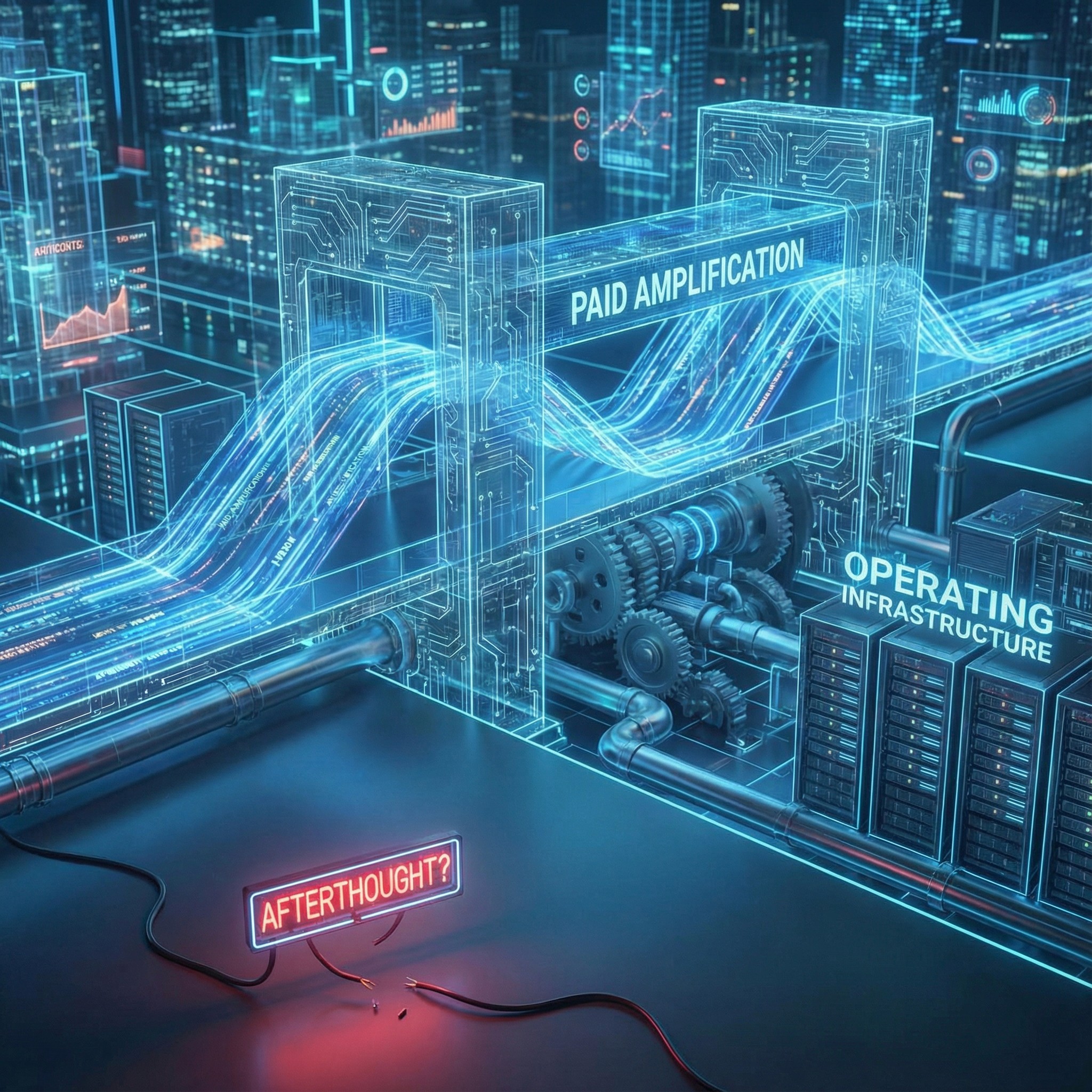
Three flavours of amplification
07/01/26
The biggest misalignment in creator budgeting is simple.
Brands still treat creator content as an organic play, then occasionally press “boost” if it looks like a winner.
That is backwards.
The future looks different. Creator content is produced for paid.
Paid amplification is core infrastructure.
Organic reach is the upside, not the plan.
The market is already reallocating
The numbers are quietly telling you what to do.
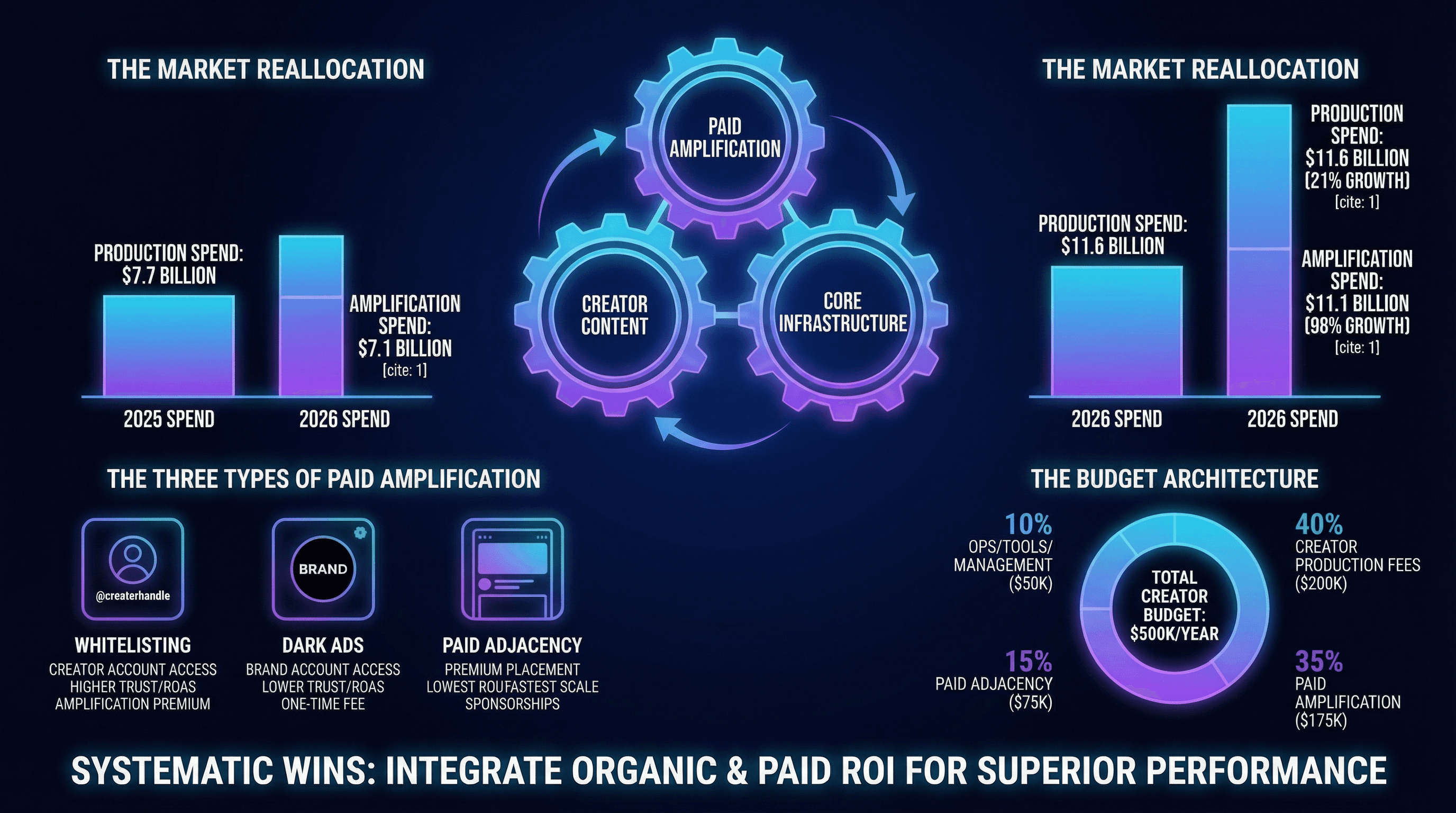
In 2025, brands spent roughly $7.7 billion on creator partnerships. In 2026 that number is projected to hit $11.6 billion. Production spend is growing, but the real jump is somewhere else.
Paid amplification of creator content is forecast to reach around $11.1 billion in 2026. That is a 56% increase from $7.1 billion the year before. Amplification is now almost matching production spend.
In practice, that means for every dollar going into making creator content, another dollar is going into pushing it through paid. Yet most teams still run “creator budget” and “paid media budget” in different silos, with different owners and different KPIs.
From a capital allocation lens, that makes no sense.
Three flavours of amplification
You do not need a new dictionary for this. There are really three motions.
Whitelisting
You run ads through the creator’s handle, using your targeting, your budget and your optimisation. The audience sees the creative coming from the creator, not the brand. Trust stays high, performance usually lifts.
ROAS tends to outperform brand-owned ads. Creators are paid for creation plus a premium for usage from their handle.
Dark ads
You take creator content, with clear rights, and run it from your own account. You get total control. The ad reads more like a brand asset, but still has the texture of creator content.
ROAS is often slightly lower than whitelisting, but still better than generic studio creative.
Paid adjacency
You buy into the environment around creator content rather than the asset itself. Sponsoring feeds, shows or formats. Easy to scale if you have budget, but usually the weakest on pure performance.
Once you see it that way, amplification is not a “nice to have”. It is the second half of the system.
A smarter budget architecture
Take a simple example. A brand with a 500K creator budget for the year.
Instead of “300K to creators, 200K to ads” in two unconnected lines, top performers think in slices:
around 40% to creator production
around 35% to paid amplification of that creator content (whitelisting plus dark ads)
around 15% to paid adjacency and sponsorship
around 10% to ops, tools and management
The mindset shifts from “how much organic reach can we squeeze from a post” to “how efficient is the total return when we blend organic and paid”.
A creator who drives modest organic results but whose content scales beautifully in paid is often more valuable than a loud organic performer whose content breaks when you put budget behind it.
The question becomes: which creator assets belong in the engine, not just on the feed.
From ad-hoc boosting to an operating rhythm
Where most teams fall down is not intent, it is orchestration.
Today it looks like this.
Something performs. Someone notices. Someone asks the paid team to “put a bit of spend behind it”. A small test runs. The moment passes.
A more modern approach looks closer to:
content is briefed and produced with amplification in mind
performance is checked in the first 24 hours
winners are flagged and moved into paid automatically
budgets shift dynamically towards the top performers
reporting blends organic and paid into one view of ROI
Same content. Same platform. Completely different operating rhythm.
The tools behind the scenes
The stack does not need to be complicated, but it does need to exist.
Most teams who are doing this well have:
something to track creators and content history (Notion, Airtable, or a dedicated creator CRM)
a simple calendar for what is being amplified, where and for how long
a dashboard that pulls organic and paid performance into one view
light automation that flags high-performing posts for review and testing
You can build that with five tools that barely talk to each other, or with two or three that are better integrated. The point is not the logo on the software. The point is that amplification is treated as a process, not a reaction.
The inflection point
Paid amplification of creator content is the fastest-growing line in the creator economy. It is outpacing production spend and it is outpacing affiliate.
By 2026, it will be assumed that every serious creator programme has a paid layer built in. By 2027, “organic only” creator work at scale will look like buying TV without ever tracking response.
The real choice is not whether you boost creator content or not.
It is whether you build a system for it or keep doing it chaotically.
Systematic wins.