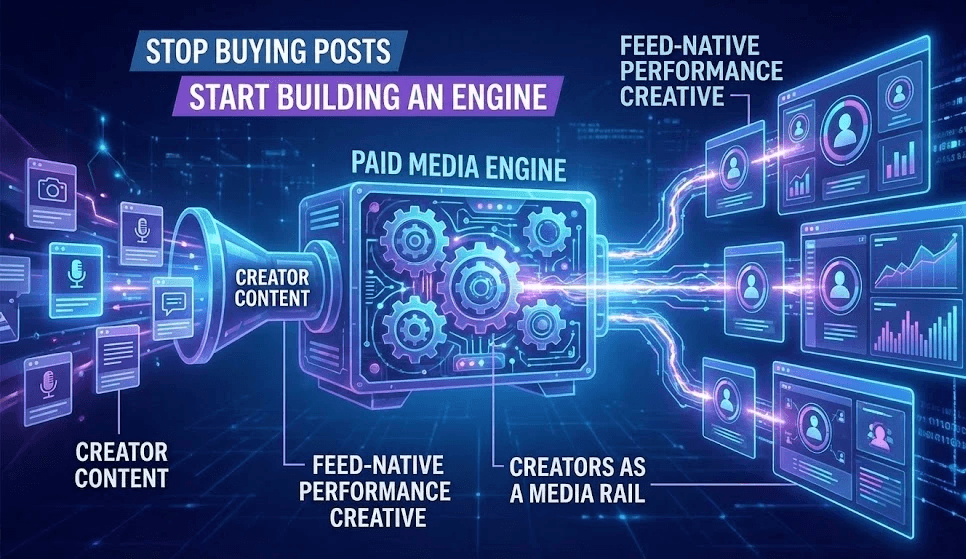
Stop buying posts. Start building an engine.
22/12/25
Most brands are sitting on a goldmine and treating it like recycling.
They brief a creator, pay for a great piece of content, watch it live for 48 hours, and then let it die in the archive. Meanwhile, they’re still funding studio shoots and brand ads that are more expensive to produce and often underperform in the feed.
The problem isn’t the creators. It’s the way the content is being used.
If you zoom out and look at your media mix like a capital allocator, a simple pattern appears: brand creative often interrupts the feed. Creator content naturally belongs in it.
Once you see creator work as feed-native performance creative, the obvious move is to stop treating it as a one-off sponsorship and start wiring it directly into your paid engine.
That’s the shift.
Creators as a media rail, not a separate budget
Most org charts put “Influencer” on a different island to “Paid Social”.
Different team. Different tools. Different language.
But the user doesn’t see those lines. They just see posts that feel like ads, and posts that feel like the people they actually chose to follow.
Creator content lives in the second bucket. It carries built-in context and trust. When you run that same creative as paid, you’re not forcing an unfamiliar brand into someone’s scroll; you’re amplifying a voice they already recognise.
Operationally, the move is simple enough: the creator makes the content, and you treat it like performance media. That’s what whitelisting and paid usage are really doing. Not as “extras”, but as the mechanism that turns creator work into an engine.
What whitelisting actually is (without the jargon)
Stripped right back, whitelisting is this: you run ads through the creator’s handle, using your targeting, your budget and your measurement.
The creator doesn’t become a media buyer. They create the asset, approve that it can be used in paid, and grant access so your ad account can run it from their profile.
You do everything you’d do with any performance campaign: audiences, budgets, testing, optimisation. To the audience, it looks and feels like a post from the creator. To your P&L, it behaves like a performance ad with a better starting point.
You’ve effectively turned a single organic post into a scalable asset – one file, pushed through multiple audiences, multiple tests, over multiple weeks of spend.
Pricing usage like an asset, not a favour
This is where deals often fall apart.
A brand asks, “Can we also boost this?” and the creator hears, “Can we use your name and face in unlimited ads for free?”
The cleanest way through is to separate creation and usage instead of bundling everything into “a post”.
Creation is one product: the thinking, shooting and editing. Usage is another: how, where and for how long that creative can be used as media.
In practice, that looks like a fee for creation and organic posting, an additional fee for paid usage from your brand handle, and a further fee if you want to run it from the creator handle via whitelisting. As you extend the time window or add more channels, the fee steps up accordingly.
You don’t need a complex rate card. You just need clarity. This is what we pay you to make the work. This is what we pay you to turn it into media for 60–90 days. If it performs and we want to keep scaling it, we pay again.
Framed that way, it feels like what it actually is: licensing an asset, not sneaking extra value out of the same fee.
Choosing the right content to put into the engine
Not every video wants to be an ad.
Some creator content is deeply personal, hyper-timely or too context-dependent. It might be brilliant for their community but feel wrong when you push it into strangers’ feeds with budget behind it.
The pieces that usually make sense to scale are the ones that show the product being used, solve a clear problem, handle an objection or explain a decision, and still make sense if someone sees them cold and without sound.
You can get to those in two ways.
One is to pre-brief: tell the creator up front you want something that can live as both organic and paid, and orient the concept around a demo, a story or a use-case that suits that.
The other is to watch what happens organically, then promote the winners. You identify the posts that spiked saves, watch-time or click-through, and move those into the paid account.
In both cases, there’s a deliberate step where you say: out of everything we produced, this is what we’re willing to treat like media.
The boring contract bit that actually protects the upside
If creator content is going to sit inside your paid engine, the paperwork has to catch up.
You don’t need ten pages of legalese. You do need a sentence or two that spells out who owns the content (usually the creator), what you’re allowed to do with it (where it can run, and for how long), whether you can cut it, caption it, crop it or re-edit it, and how extensions work if the ad keeps performing.
The mindset shift is to treat this as a time-bound licence to use that asset in specific ways, rather than a grab for outright ownership.
That’s more comfortable for creators. And it’s cleaner for you: you know exactly what you’re allowed to do, and you can confidently invest behind the creative because the rights are clear.
Measure it like performance media, not sponsorship
Once an asset goes into the paid account, it should be treated exactly the way you treat any other performance creative.
You test creator ads against your studio ads. You look at click-through, cost per click, cost per acquisition, ROAS and payback – not just comments and likes. You cut what doesn’t work and scale what does.
A simple experiment is enough to make the case internally. Same audience, same budget, same offer and landing page. One version from the brand handle. One version from the creator handle.
If the creator-handle version consistently wins on CAC or ROAS, you now have a concrete argument: when we treat creator content as part of our media system, we improve the cost and quality of growth.
It’s no longer a “brand” conversation. It’s a capital efficiency conversation.
The reallocation that actually matters
Most media plans still tuck creator work into the corner: a spend line for posts, and then a separate paid budget for brand creative.
A more modern split doesn’t necessarily increase total spend on creators. It changes where the creator content sits. Less in the “organic only” bucket, more in the “performance” bucket.
In practice, that might look like taking a portion of your existing paid budget and committing that it will be spent amplifying creator-originated assets, not just studio ones. Same budget. Different mix. Less money on content that interrupts the feed. More money on content that already belongs in it.
If the numbers stack up – and they usually do once you’re disciplined about selection and rights – you aren’t “doing more influencer marketing”. You’re upgrading the quality of your media.
The shift
The old question was: how many posts can we get for this creator budget?
The new question is: which creator assets belong in our paid engine, and how do we structure rights and pricing so we can scale them?
For brands, that shift turns creators from “nice awareness” into a lever on CAC and ROMI.
For creators, it turns a single cheque into a relationship where their best work gets amplified, measured and paid accordingly.
That’s the difference between treating creator content as a campaign line item and treating it as part of the system.