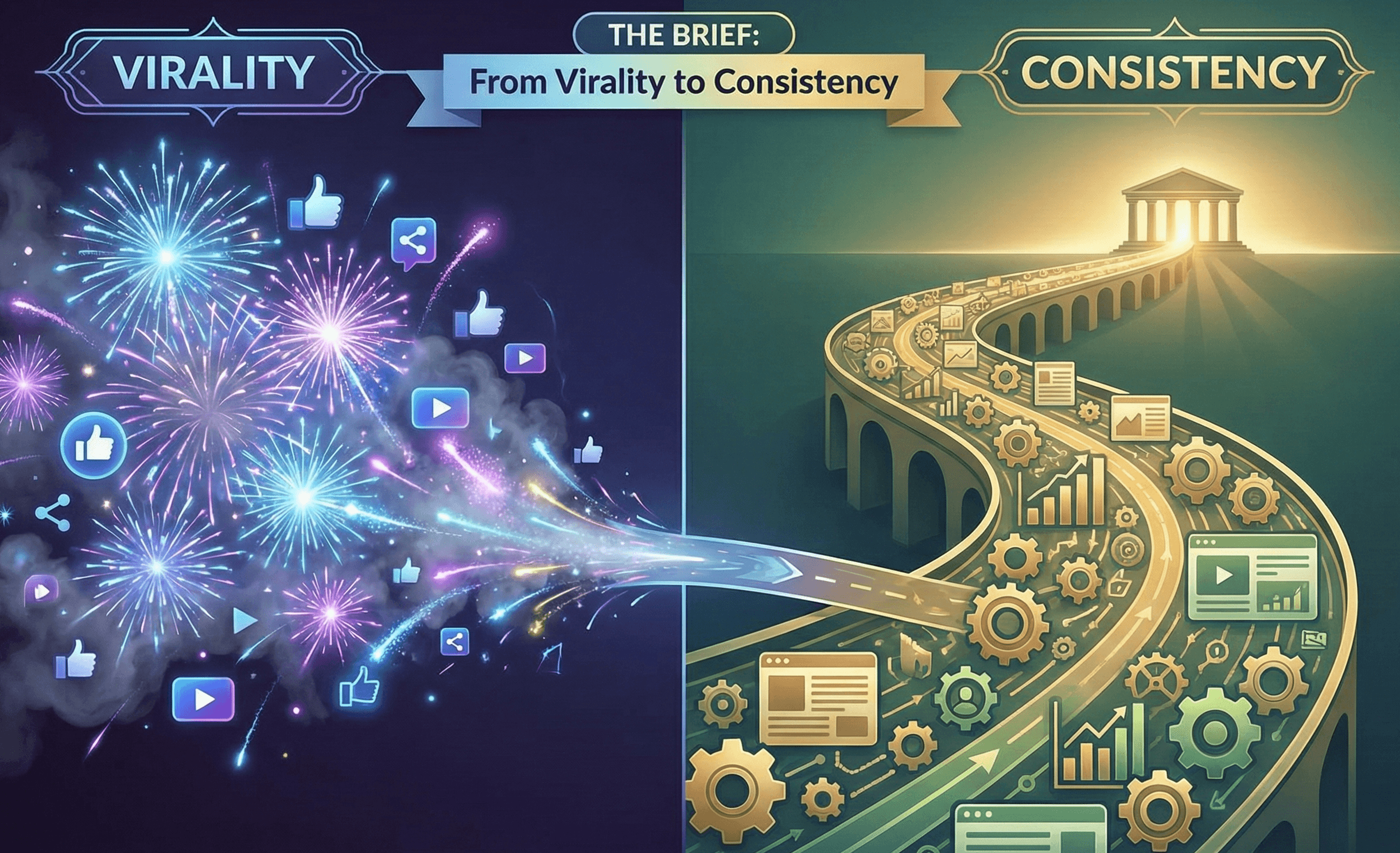
Building Predictable Creator Systems in 2026
11/08/26
Building Predictable Creator Systems in 2026
The creator economy is going through a quiet philosophical shift.
The era where one viral hit could carry a career is fading. The era where creators and brands build repeatable systems is taking over.
In 2026, the winners will treat content like infrastructure. Not stunts.
The Virality Trap
The historical creator success story used to be simple: one viral video, millions of views overnight, inbound brand deals, momentum for months.
That story still happens, but it is a weak business model.
Virality is not a strategy. It is a spike. It is also fragile.
Algorithms change, formats saturate, audiences move on, policies tighten. Even when the views land, the business often does not.
The trap is that virality feels like proof. It looks like leverage. It creates noise. But it does not automatically create a repeatable engine.
And the moment a creator relies on spikes, they start living in a loop: chase the next hit, force the next angle, stretch the identity, burn out the audience, burn out themselves.
Why “Viral” Often Fails to Monetise
Here’s the uncomfortable truth.
A creator can go viral and still struggle to monetise because:
they do not own the audience (no list, no community, no retained subscribers)
they do not have consistent formats that build repeat viewership
brands cannot forecast outcomes, so they hesitate to commit recurring budget
the audience came for the moment, not the message
Views are attention. Business requires repeatability.
The Consistency Opportunity
Consistency is not “posting more”. It is creating a system where output is predictable, the format is recognisable, and the audience habit is trained.
A consistency-driven creator looks like this:
they post on a steady schedule
they run recurring formats people anticipate
they build repeat viewership, not one-off spikes
they develop owned channels alongside rented reach
they generate predictable outcomes, which is what brands and partners actually buy
Here’s a simple illustrative example.
If a creator publishes 2 posts per week and averages 50,000 views per post, that’s around 400,000 views per month. If even 0.25% of viewers take a measurable action (click, sign-up, landing-page visit), that is 1,000 actions per month, without needing a single viral moment.
That is infrastructure.
Why Brands Are Shifting
Brands are shifting away from one-off stunts for three reasons.
First, budgets are getting stricter and paid amplification is growing. When a brand is putting media behind creator content, they want reliable output and reliable creative supply, not random spikes. Creator marketing is also getting bigger overall, which increases the pressure to professionalise how it is run.
Second, audiences are more sceptical of “viral performance”. They trust creators who show up consistently, not just creators who hit occasionally.
Third, creator burnout is real. The “chase virality” loop is emotionally expensive. Sustainable creators are building systems because it reduces stress and increases leverage.
The MrBeast Point
The Exception That Proves the Rule
If anyone could argue “virality is the model”, it is MrBeast.
But what is happening inside the biggest creator businesses is not “we hope it goes viral”. It is “we build repeatable viral systems, then operationalise them”.
MrBeast’s team has been hiring a Head of Viral Marketing (Products & Services) with a remit that explicitly reads like a system: converting cultural moments into sign-ups, activation, revenue, retention, and repeat engagement.
Digiday’s read on this move is essentially that even a founder with elite instincts cannot carry the machine alone forever. The point is scale through process, not relying on a single brain and luck.
So MrBeast is not a counterexample. He is the endgame of the thesis.
Virality is becoming an operating function inside a system, not a vibe.

Building the Consistency System
How predictable creators actually operate
The shift for creators is moving from “posting content” to “running a media engine”.
That engine has four parts.
1) A franchise, not a feed
Instead of random posts, build named formats that repeat. Audiences do not just follow creators, they follow expectations.
2) A production system, not bursts of motivation
Templates, filming days, edit workflows, and a content backlog. Predictability comes from planning, not mood.
3) A distribution plan, not hope
Same format, multiple cuts, multiple platforms, and a clear role for each channel (discovery, depth, conversion, community).
4) Audience ownership, not pure rented reach
Email list, community, subscriber products, close friends lists, whatever fits the niche. The goal is retaining attention beyond the algorithm.
How Brands Partner With Consistent Creators
Brands are also evolving how they structure partnerships.
The next wave of deals will look less like “do 4 posts” and more like “sponsor a format”.
Instead of buying output, brands buy placement inside an existing franchise.
That reduces risk for everyone:
the creator knows exactly what they are making
the brand knows exactly what it will look like
the audience knows what to expect
the platform tends to reward the repeat pattern
This is also where “series” beats “standalone”.
A standalone post is a lottery ticket. A 4-part series builds anticipation and trains repeat viewing.
The Measurement Shift
The metric shift is subtle but important.
The old question was: “Did it go viral?”
The new question is: “Did it perform within predicted range and did it build repeatable audience behaviour?”
That is how brands start thinking when creator marketing becomes a budget line they want to scale, not an experiment they tolerate.
CreatorIQ’s 2025–26 work is basically pointing at the same macro direction: creator marketing is professionalising, measurement is tightening, and paid amplification is increasingly central to strategy.
Why Creators Win When They Choose Consistency
Creators who build systems gain three unfair advantages.
They earn more because brands pay for reliability and repeatable outputs.
They retain audiences because people come back when there is a routine.
They reduce stress because the “what do I post” chaos disappears.
Consistency builds positioning. Positioning builds pricing power.
Virality becomes a bonus, not the business model.
The 2026 Prediction
By the end of 2026, the creators winning will look more like media companies than influencers.
They will have:
a predictable publishing rhythm
named franchises and repeat formats
owned audience channels
multiple revenue streams beyond brand deals
professional operations and systems
Brands will win by recognising that consistency is a strategic asset and investing in recurring partnerships that build audience habits.
The creators still chasing spikes will still get moments. But they will increasingly find it harder to build predictable businesses around those moments.